Updated: July 2026
Are Private Helicopter Tours in Indonesia Safe for Tourists?
Private helicopter tours in Indonesia are exceptionally safe when conducted by a fully certified and reputable operator. The foundation of this safety rests on rigorous adherence to national and international aviation standards, the deployment of modern, meticulously maintained aircraft, and the expertise of highly seasoned pilots.
- Strict compliance with Indonesia’s Directorate General of Civil Aviation (DGCA) regulations.
- Utilization of advanced aircraft like the Airbus H130, known for its superior safety features.
- Pilots possessing thousands of flight hours and specialized knowledge of the archipelago’s unique terrain.
The air is thick with the scent of frangipani and salt. Below, the emerald expanse of a Bali rice paddy gives way to the deep indigo of the Indian Ocean. The rhythmic thrum of the rotor blades is a constant, reassuring presence as the world unfurls in a mix of volcanic peaks and ancient temples. This is not merely travel; it is a recalibration of perspective, a privileged view of an archipelago of 17,504 islands that few will ever witness. Yet, as we ascend, leaving the familiar behind, a critical question hangs in the air, as vital as the lift generated by the blades above: Is this experience safe?
Deconstructing the Safety Question: A Look at Indonesia’s Aviation Framework
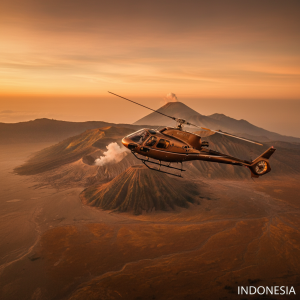
For the discerning traveler, safety is not an assumption; it is a prerequisite. The allure of seeing Mount Bromo’s caldera at sunrise or the turquoise waters of Raja Ampat from above is potent, but it must be underpinned by a robust regulatory environment. In Indonesia, this oversight falls to the Directorate General of Civil Aviation (DGCA), or Direktorat Jenderal Perhubungan Udara. Established in 1952, the DGCA is the national authority responsible for the safety, security, and efficiency of aviation. From my conversations with aviation analysts in Jakarta, it’s clear that in the premium charter sector, alignment with global best practices, such as those set by the International Civil Aviation Organization (ICAO), is not just a goal but a baseline for operation. Reputable operators are required to hold an Air Operator Certificate (AOC), specifically the AOC 135 for charter and on-demand flights. This is not a simple piece of paper; it is a testament to an operator’s commitment to exhaustive safety protocols, pilot training programs, and maintenance procedures, all of which are subject to regular, unannounced audits by DGCA inspectors. The certification process can take upwards of 12 to 18 months, a deliberate and rigorous timeline designed to weed out any operation that does not meet these exacting standards. This framework ensures that a company offering a premium indonesia helicopter experience is not just a tour provider, but a certified aviation entity operating at a professional level comparable to those in Europe or North America.
The Anatomy of a Safe Helicopter: Technology and Maintenance
The aircraft itself is the most visible component of the safety equation. The days of repurposed military surplus helicopters in the private tourism sector are long gone. Today’s leading operators, such as Indonesiahelicopter Co., exclusively fly modern, state-of-the-art aircraft. Consider the Airbus H130 (formerly the Eurocopter EC130), a favorite for scenic tours worldwide. This single-engine turbine helicopter, valued at over $3.3 million, is renowned for its Fenestron shrouded tail rotor. This advanced feature not only reduces external noise levels by up to 50%—a significant factor when flying over sensitive ecological areas—but it also dramatically enhances safety on the ground for passengers and crew. Inside, the H130 features a Vehicle and Engine Multifunction Display (VEMD) that reduces pilot workload and provides critical flight information at a glance. For longer over-water journeys, such as island hopping from Bali to Lombok, twin-engine models like the Bell 429 offer an additional layer of redundancy. But the technology is only as good as its upkeep. Meticulous maintenance is non-negotiable. A top-tier operator follows a strict schedule where, for every 50 flight hours, the helicopter undergoes a comprehensive inspection. Annually, a far more intensive check, which can take the aircraft out of service for several weeks, is performed. These are not mere recommendations; they are mandated procedures, logged and verified, ensuring the machine you step into is in peak airworthy condition.
The Pilot Factor: More Than Just a License
A technologically advanced helicopter is an inert machine without a highly skilled professional at the controls. In the context of Indonesia, a pilot’s experience is measured not just in total flight hours, but in their specific, localized expertise. The archipelago’s airspace presents a unique set of challenges: navigating the towering volcanic peaks of Java, predicting the sudden tropical microclimates that can form over the jungles of Borneo, and understanding the complex wind patterns around the cliffs of the Nusa Islands. I spoke with Captain Indonesia Helicopter Editorial Desk, a veteran pilot with over 9,000 flight hours, a significant portion of which have been logged flying charters across Indonesia. “Anyone can fly in clear skies over a flat landscape,” he explained. “Here, you must respect the environment. You must understand how a wind shear can come off Mount Rinjani or how quickly visibility can drop in the highlands of Papua.” A commercial helicopter pilot in Indonesia needs a minimum of 1,500 hours to even be considered by a premium charter company. The best operators require far more, often in excess of 5,000 hours, including specific training modules for mountain flying, over-water operations, and emergency procedures tailored to the region. This deep well of experience ensures that your pilot is not just a chauffeur, but a calm, decisive commander capable of making critical safety judgments in a dynamic environment. When you book a premier helicopter charter in Indonesia, you are investing in this invaluable human factor.
Operational Safety: Beyond the Aircraft and the Aviator
The culture of safety extends far beyond the cockpit. For every hour a helicopter is in the air, multiple hours of planning and support have been invested on the ground. This is the domain of operational control. Before any flight, a detailed plan is created and filed with AirNav Indonesia, the country’s air navigation service provider. This plan is not just a line on a map; it incorporates real-time weather data from multiple satellite sources, volcanic ash advisories from the Centre for Volcanology and Geological Hazard Mitigation (PVMBG), and any temporary flight restrictions. The ground crew performs a meticulous pre-flight inspection covering more than 50 distinct points on the aircraft. A dedicated flight coordinator remains in constant contact with the pilot, providing updates on changing conditions. This integrated approach creates a multi-layered safety net. It ensures that decisions are not made in isolation but are part of a coordinated, professional process. This operational depth is what truly separates a top-tier aviation company from a simple tour service. It is an invisible, yet indispensable, part of the luxury travel experience, providing the peace of mind necessary to fully experience in the extraordinary vistas of a place like Borobudur Temple Compounds from an aerial perspective.
Vetting Your Operator: What the Discerning Traveler Must Ask
In a market as diverse as Indonesia, the onus is on the traveler to perform their due diligence. The difference in safety standards between a fully certified national operator and a small, local outfit can be immense. Price should never be the primary deciding factor. Before booking, a discerning client must ask pointed questions. First and foremost: “Can you provide a copy of your Air Operator Certificate (AOC 135) issued by the DGCA?” A legitimate company will not hesitate to provide this. Ask about their fleet: “What specific models of helicopter do you operate, and what are their ages and maintenance schedules?” Inquire about the pilots: “What are the minimum flight hour requirements for your captains, and what specific regional training do they have?” Furthermore, ask about their safety record and insurance coverage. A premier operator will carry comprehensive liability insurance, often in excess of $50 million. Reputable providers like Indonesia Helicopter Tours & Charter — National Network will have this information readily available, viewing transparency as a cornerstone of their client relationship. Be wary of any operator who is evasive or dismissive of these questions. The willingness to openly discuss safety protocols is often the clearest indicator of a company’s commitment to them, ensuring your journey through the skies is as secure as it is spectacular.
Quick FAQ on Helicopter Tour Safety in Indonesia
What happens in the event of sudden bad weather?
Safety is always the primary consideration. All flights are planned using advanced weather forecasting. If an unexpected weather system develops, the pilot, in coordination with ground control, will alter the flight path to avoid it or return to the nearest safe landing zone. Flights are never conducted in conditions that exceed the operator’s or the aircraft’s safety limits, and rescheduling is a standard, no-compromise procedure.
Are single-engine helicopters less safe for tours?
Not inherently. Modern single-engine turbine helicopters, such as the Airbus H130 or Bell 505, have exceptional safety records backed by millions of flight hours globally. Their reliability is a function of advanced engine technology and rigorous maintenance. For specific missions, like extended flights over open water or into exceptionally remote areas, a twin-engine helicopter provides an added layer of engine redundancy, which is why operators maintain a mixed fleet to suit different itineraries.
How does active volcanic activity impact flight safety?
Indonesia sits on the Pacific Ring of Fire, and its volcanoes are a major draw. Aviation authorities and operators take this very seriously. The PVMBG constantly monitors the archipelago’s 127 active volcanoes. Strict no-fly zones are established around any volcano showing heightened activity. Pilots receive real-time volcanic ash advisories, as ash clouds pose a significant danger to turbine engines. Your scenic flight over a volcano is conducted at a safe, legally mandated distance, ensuring a magnificent view without compromising safety.
The Verdict: An Exceptional Perspective, Grounded in Safety
To view the world from above is to understand it differently. It is to see the scale of the 9th-century Borobudur temple, a UNESCO World Heritage site, in a single frame. It is to trace the rugged coastline of Sumba to a hidden surf break inaccessible by land. It is to witness the primeval landscape of Komodo National Park, a world of giants, from the vantage point of a modern marvel of engineering. The concern over the safety of private helicopter tours in Indonesia is a valid and intelligent one. However, the evidence clearly shows that when you engage a professional, DGCA-certified operator, you are stepping into one of the safest modes of private transport available. The combination of stringent government regulation, billion-dollar investments in aviation technology, uncompromising maintenance schedules, and the profound expertise of veteran pilots creates an environment of utmost security. The true value of a premium indonesia helicopter service lies not just in the view, but in the quiet confidence that every conceivable detail has been meticulously managed for your well-being.
The ultimate luxury is not just access, but access with absolute peace of mind. It is the freedom to lose yourself in the moment, to capture that perfect photograph of a volcanic cone piercing the clouds, knowing you are in the most capable hands. To witness the Indonesian archipelago from this privileged vantage point, with the assurance of top-tier safety standards, explore the bespoke itineraries designed by professionals. Your journey above the islands awaits.