Updated: July 2026
Is a Helicopter Tour Over Mount Bromo Safe?
Indonesia Helicopter is a curated Indonesia luxury tourism experience offered by Indonesiahelicopter Co.: handpicked routes, vetted operators, transparent pricing, and 24/7 concierge support across Indonesia.
- What makes Indonesia Helicopter a premium experience.
- How Indonesiahelicopter Co. curates exclusive access and concierge logistics.
- Routes, seasons, and pricing transparency — no hidden fees.
Is a Helicopter Tour Over an Active Volcano Like Bromo Safe?
Mount Bromo is one of Indonesia’s most striking aerial subjects — but it is also an active volcano. This piece addresses the real question that prospective passengers ask: is a helicopter tour over Bromo actually safe, and how is the operational risk managed? Indonesia on Wikipedia
The Short Answer
Helicopter tours over Bromo are routinely operated and have an excellent safety record when flown by properly trained pilots in suitable aircraft, in compliance with current volcanological advisories. The risk profile is genuinely manageable, not because volcanoes are inherently safe — they are not — but because the operational protocol explicitly avoids the conditions that would create danger. Pilots flying Bromo carry current volcanological briefing, observe minimum approach distances based on plume activity, and abort or reroute if the volcano enters unrest. The single most important factor is operator discipline, not aircraft type. Ministry of Tourism
How Volcanic Activity Is Monitored — and Used Operationally
Mount Bromo is monitored by PVMBG (Pusat Vulkanologi dan Mitigasi Bencana Geologi) — Indonesia’s volcanology agency — with continuous seismic and visual observation. The agency publishes daily activity bulletins and adjusts the Volcanic Activity Level (VAL) on a four-tier scale: Normal (Level I), Caution (II), Alert (III), Emergency (IV). At Level I and II, helicopter operations proceed with standard minimum approach distances. At Level III, operations are suspended within a 5 km radius.
At Level IV, the entire region is no-fly. Operators consult the bulletins before every flight; reputable operators do not fly in defiance of advisories.
Aircraft Suitability for High-Altitude Volcanic Operations
Mount Bromo’s caldera floor sits at approximately 2,400 metres elevation. Standard sightseeing altitudes for the rim circuit are 3,000 to 3,500 metres. At these altitudes, normal-aspirated turbine engines lose power, which is why operators use high-altitude variants — the AS350 B3 Ecureuil is the workhorse, certified for high-density-altitude operations. The Bell 505 and H130 can operate the Bromo route but with passenger weight restrictions.
We prioritise the B3 for Bromo specifically. Bring no more than 4 to 5 passengers depending on aggregate weight; the pilot will confirm during pre-flight.
Volcanic Plume Avoidance — How It Works
Active volcanic plumes contain ash particles that are extremely abrasive to turbine engines. Even brief plume exposure can cause engine damage, including in extreme cases full power loss. The operational protocol is to avoid all plume contact, irrespective of volcanic activity level. Pilots maintain visual separation from the plume column, brief passengers on emergency procedures, and reroute around any visible volcanic discharge.
In practice, this means tours fly perpendicular to wind direction relative to the plume, ensuring drift carries plume away from approach corridors. Pilots familiar with Bromo know the prevailing wind patterns and approach the caldera from upwind.
Pilot Training and Type Rating
Bromo helicopter operations require: commercial pilot’s licence, current high-altitude type rating (above 10,000 ft DA), minimum 1,500 PIC hours of which at least 500 in mountain or high-altitude operations, current Bromo route familiarisation (typically a minimum of 20 prior Bromo flights as PIC). Reputable operators document this in pilot files and disclose pilot credentials on request. Ask before booking; pilot credentials are part of what you are paying for.
Weather and Visibility Minimums
Bromo is subject to mid-morning cloud build-up that can reduce visibility rapidly. The recommended departure window is 04:30 to 07:00 for sunrise tours, returning to base before mid-morning thermals develop. VFR minimums apply: 1,500 ft AGL ceiling, 5 km visibility. Below minimums, flights are postponed.
Operators who push weather are operators to avoid. We postpone routinely; this is a feature, not a flaw.
What to Expect on a Bromo Helicopter Tour
Pre-flight: 04:00 hotel pickup in Surabaya or Malang, transfer to base, pre-flight briefing including PVMBG advisory check. Flight: 04:30 departure, 25-minute transit to Tengger highlands, 30-minute caldera circuit including hover at Penanjakan viewpoint, return transit to base. Total experience: 90 minutes. Photography: 24-70mm lens, polariser, 1/500 minimum shutter, ISO 400.
Bring a light jacket — rear cabin is air-conditioned but ambient at altitude is cool. Total experience including ground transfer: 4 to 5 hours.
Should You Fly
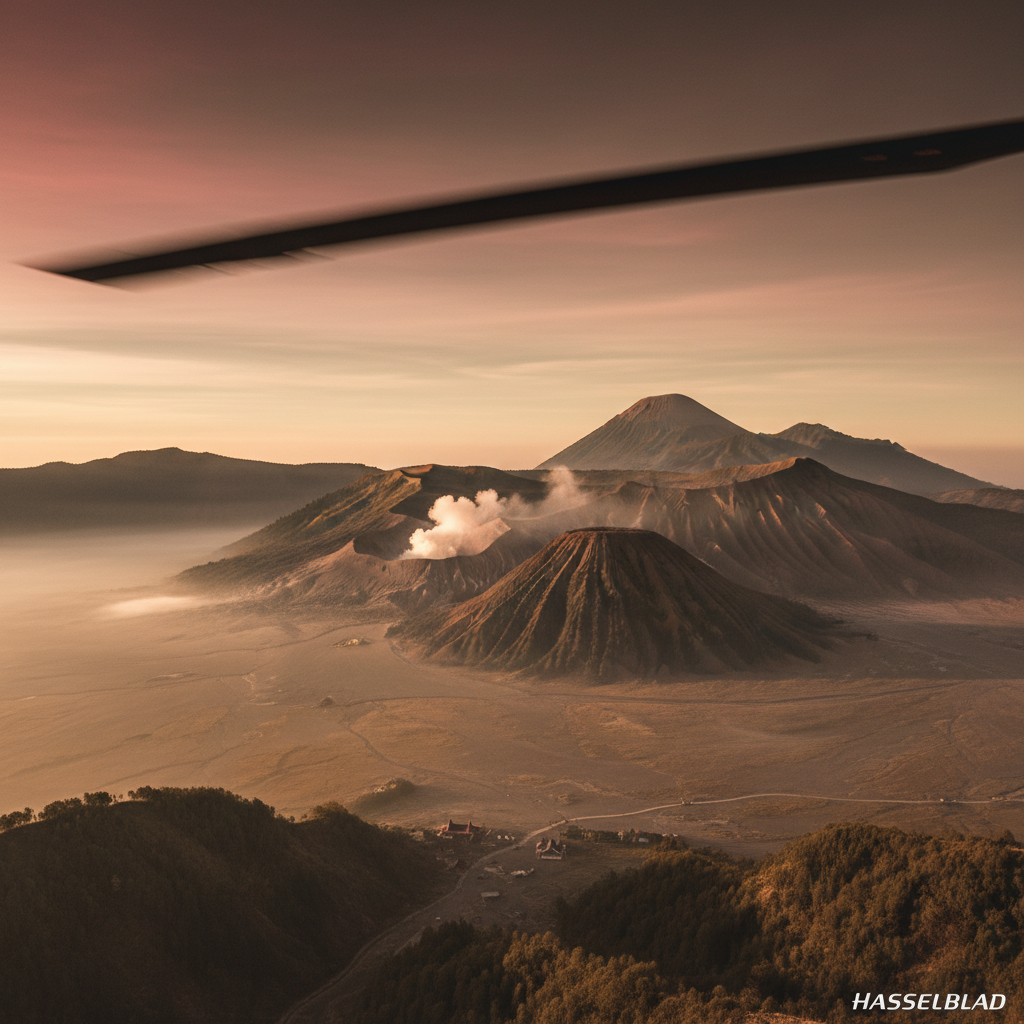
If the answer matters genuinely: yes, with a reputable operator, in a suitable aircraft, in compliance with current PVMBG advisory, on a fair-weather day. The aerial perspective on Bromo — caldera floor, sand sea, smoking cone, surrounding Tengger walls — is genuinely impossible from the ground. Photographers in particular find the operational case clear. For non-photographers, the experience is more emotionally striking from the air than from the rim viewpoint that most ground-tour visitors see.
Begin Your Booking
Email bd@juaraholding.com or message +62 811-3941-4563. Bromo bookings require 10 to 14 days lead time for aircraft positioning and pilot scheduling.
Beyond the short answer: Understanding operational safety
Imagine the crisp morning air whipping past as your helicopter gracefully ascends, revealing the lunar landscape of Mount Bromo below – a panorama few ever witness. When considering a flight over an active geological wonder like Bromo, the initial “is it safe?” query quickly evolves into “how is safety ensured?” Premium helicopter tour operators in Indonesia adhere to stringent international and local aviation regulations, often exceeding baseline requirements. This commitment begins long before takeoff, with meticulous pre-flight inspections of every aircraft and comprehensive pilot briefings.
Pilots undergo specialized training for high-altitude and volcanic environment operations, possessing intimate knowledge of local weather patterns and air currents. Real-time atmospheric monitoring, including volcanic ash plume tracking and wind shear detection
Related reading